Causes of Fecal Debris Under Toilet Seats in Public Restrooms
Exploring the causes and mechanisms of fecal debris accumulation under toilet seats in public restrooms, including cleaning practices, flushing aerosols, and contamination patterns.
What causes fecal debris to accumulate underneath toilet seats, and what are the possible mechanisms that explain this phenomenon in public restrooms?
Fecal debris accumulates underneath toilet seats primarily due to inadequate cleaning practices, high traffic usage in public restrooms, and the mechanical process of flushing that creates aerosols containing contaminated particles. The combination of poor maintenance, insufficient cleaning protocols, and the natural physics of toilet flushing creates an environment where fecal matter can deposit on the undersides of toilet seats, particularly in high-use public facilities.
Contents
- Understanding Fecal Debris Accumulation Under Toilet Seats
- Primary Causes in Public Restroom Environments
- Mechanical Mechanisms: Flushing and Aerosolization
- Cleaning Practices and Their Impact on Debris Buildup
- Gender Differences in Contamination Patterns
- Prevention Strategies and Best Practices for Public Restrooms
- Sources
- Conclusion
Understanding Fecal Debris Accumulation Under Toilet Seats
Fecal debris accumulation underneath toilet seats represents a significant sanitation challenge in public restroom environments. This phenomenon occurs when microscopic and visible particles of human waste deposit on the undersides of toilet seats through various biological and mechanical processes. The accumulation not only poses aesthetic concerns but also creates potential health hazards as it can harbor pathogenic organisms that may be transmitted to users through direct contact or indirect surface contamination.
Several factors contribute to this issue, including the design of toilet systems, cleaning protocols, and usage patterns. In public restrooms specifically, the high volume of users combined with varying standards of cleanliness creates conditions where fecal debris can accumulate over time. The undersides of toilet seats often receive less attention during routine cleaning, making them particularly vulnerable to contamination and buildup of waste materials.
Primary Causes in Public Restroom Environments
The primary causes of fecal debris accumulation under toilet seats in public restrooms are multifaceted, involving both human behavior and environmental factors. Inadequate cleaning practices represent a major contributing factor, as many public restroom cleaning routines focus on visible surfaces while neglecting the undersides of toilet seats. The research from the Cleaning Industry Research Institute indicates that “acceptable” restrooms typically still show “a little human waste on the underside of the toilet seats,” highlighting the prevalence of this issue even in facilities considered reasonably maintained.
High traffic usage in public restrooms accelerates the accumulation process. As numerous individuals use the facilities throughout the day, the likelihood of contamination increases significantly. The constant exposure to human waste particles, combined with insufficient drying time between uses, creates an environment where debris can adhere to surfaces rather than being washed away. Additionally, the design of many public restrooms, with their emphasis on functionality over hygiene, often creates spaces where cleaning is challenging and debris can easily go unnoticed until it builds up to problematic levels.
Another significant factor is the lack of comprehensive training for cleaning staff. Many custodians may not understand the importance of cleaning all surfaces of toilet seats, particularly the undersides, leading to inconsistent cleaning practices. This knowledge gap, combined with time constraints and inadequate resources, results in cleaning efforts that fail to address the full scope of contamination in public restrooms.
Mechanical Mechanisms: Flushing and Aerosolization
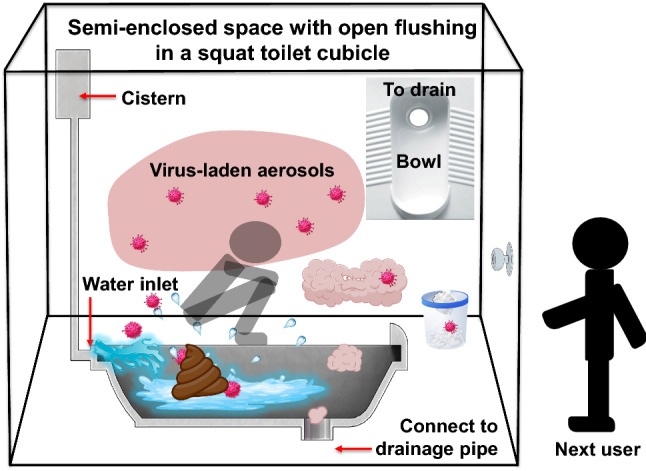
The mechanical process of toilet flushing plays a crucial role in explaining how fecal debris accumulates underneath toilet seats. When toilets are flushed, water rushes into the bowl with significant force, creating powerful turbulences that can propel contaminated particles upward. Research published in PubMed Central reveals that these flushing mechanisms generate strong turbulences with upward velocities reaching up to 5 meters per second, carrying fecal matter and urine droplets onto nearby surfaces, including the undersides of toilet seats.
This aerosolization process creates a phenomenon known as “toilet plume,” where microscopic particles of waste become airborne and settle on surrounding surfaces. The absence of properly designed U-traps in many toilet systems exacerbates this issue, allowing sewage droplets and aerosols to rise from drainage pipes and contaminate toilet seat undersides. The diagram from the research illustrates how contaminated water droplets can travel significant distances during flushing, explaining why even remote areas under toilet seats become contaminated.
The physics of flushing is particularly problematic in public restrooms where toilet seats are often left up during use. When the toilet is flushed with the seat elevated, contaminated water can directly contact the seat underside, depositing fecal debris that remains until the next cleaning cycle. This mechanical mechanism explains why public restrooms experience more significant accumulation than private bathrooms, where seats are more consistently kept down during flushing.
Cleaning Practices and Their Impact on Debris Buildup
Cleaning practices significantly influence the accumulation of fecal debris under toilet seats in public restrooms. The Cleaning Industry Research Institute study highlights that mops used for cleaning often contain coliform bacteria, which can spread contamination from floor areas to toilet surfaces during the cleaning process. This cross-contamination means that even when cleaning occurs, it may inadvertently transfer fecal matter to the undersides of toilet seats rather than removing it.
The frequency and thoroughness of cleaning directly impact debris buildup. Inadequate cleaning schedules, where restrooms are not cleaned frequently enough, allow fecal debris to accumulate and become more firmly attached to surfaces. Additionally, improper cleaning techniques—such as using the same cloth for multiple surfaces or failing to use adequate disinfectant—fail to effectively eliminate microbial contamination. Many cleaning protocols focus on visible surfaces while neglecting the undersides of toilet seats, creating blind spots where debris can accumulate undetected.
Chemical cleaning agents also play a role in debris management. Ineffective or improperly diluted disinfectants may not fully sanitize surfaces, leaving behind residual organic matter that can attract and retain fecal particles. Conversely, harsh chemicals that degrade surfaces over time can create microscopic crevices where debris becomes trapped, making subsequent cleaning more difficult. The balance between effective sanitation and surface preservation is often challenging in public restroom environments where both cost and effectiveness must be considered.
Gender Differences in Contamination Patterns
Research from the Cleaning Industry Research Institute reveals significant gender differences in contamination patterns in public restrooms. Female restrooms consistently show higher contamination rates than male restrooms, with toilet areas contaminated 1.8 times more frequently with coliform bacteria. This disparity can be attributed to several factors specific to female restroom usage patterns and design considerations.
One explanation is the frequency and duration of restroom visits. Women typically spend more time in restroom stalls, increasing the opportunity for contamination of various surfaces, including toilet seats. Additionally, female restroom usage often involves more complex activities that may contribute to the spread of fecal matter. The research specifically notes that single-stall facilities experience the highest contamination rates (31.5% of sites with total coliforms), likely because they experience higher usage frequency and may not accommodate the same volume of traffic as larger facilities.
Gender differences in hygiene behaviors also play a role. Women may be more likely to use seat covers or paper to create barriers between themselves and the toilet seat, which can sometimes dislodge existing debris or create additional particles that accumulate on the undersides of seats. Furthermore, female restrooms often contain additional fixtures like sanitary disposal units that can complicate cleaning routines and create additional surfaces where fecal debris might accumulate indirectly.
Prevention Strategies and Best Practices for Public Restrooms
Addressing the accumulation of fecal debris under toilet seats in public restrooms requires a multi-faceted approach combining improved design, enhanced cleaning protocols, and user education. Implementing comprehensive cleaning schedules that specifically address the undersides of toilet seats can significantly reduce debris buildup. Cleaning staff should be trained to lift seats and thoroughly clean both top and bottom surfaces using appropriate disinfectants effective against fecal coliform bacteria.
Technological solutions offer additional prevention strategies. Installing modern toilet systems with enhanced U-traps and improved flushing mechanisms can reduce aerosolization and the spread of contaminated particles. Automatic seat-closing mechanisms ensure seats remain down during flushing, preventing direct contact between contaminated water and the seat underside. Some facilities have found success with antimicrobial coatings on toilet seats that inhibit bacterial growth and make cleaning more effective.
User education represents another critical component of prevention. Clear signage reminding users to close toilet seats before flushing can help reduce the spread of contaminated particles. Additionally, providing adequate supplies like seat covers, disinfectant wipes, and hand sanitizer encourages better hygiene practices among users. Public restroom managers should also consider implementing monitoring systems to identify areas of persistent contamination and target cleaning efforts accordingly.
Finally, regular assessment and improvement of restroom infrastructure can address underlying design issues that contribute to debris accumulation. This includes ensuring proper ventilation to reduce humidity (which promotes microbial growth), repairing leaks promptly, and updating fixtures to more hygienic designs. By combining these strategies, public restroom facilities can significantly reduce the accumulation of fecal debris under toilet seats and improve overall hygiene standards.
Sources
- Cleaning Industry Research Institute — Study on enteric bacterial contamination of public restrooms and fecal debris accumulation patterns: https://ciriscience.org/ieq-measurement/enteric-bacterial-contamination-of-public-restrooms/
- PubMed Central (PMC) — Research on flushing mechanisms and aerosolization of fecal matter during toilet use: https://pmc.ncbi.nlm.nih.gov/articles/PMC7700112/
Conclusion
Fecal debris accumulation underneath toilet seats in public restrooms results from a complex interplay of mechanical processes, inadequate cleaning practices, and high traffic usage. The flushing mechanism itself creates aerosols that can propel contaminated particles onto undersides of toilet seats, while poor cleaning protocols allow this debris to persist and accumulate over time. Gender differences in restroom usage patterns further influence contamination rates, with female restrooms showing significantly higher levels of fecal bacteria. Addressing this issue requires a comprehensive approach that combines improved toilet design, enhanced cleaning protocols, user education, and regular assessment of restroom infrastructure. By understanding these mechanisms and implementing targeted prevention strategies, public restroom facilities can significantly reduce the accumulation of fecal debris and improve overall hygiene standards for all users.
Fecal debris accumulates underneath toilet seats primarily due to inadequate cleaning practices and high traffic usage in public restrooms. The study found that “acceptable” restrooms typically had “a little human waste on the underside of the toilet seats,” indicating this is a common occurrence when restrooms aren’t maintained to excellent standards. Female restrooms showed significantly higher contamination rates than male restrooms, with toilet areas contaminated 1.8 times more frequently with coliform bacteria. Single-stall facilities were the most contaminated (31.5% of sites with total coliforms), likely because they experience higher usage frequency. Mops used for cleaning were found to contain coliform bacteria, which could spread contamination from floor areas to toilet surfaces during cleaning procedures.
Fecal debris accumulates underneath toilet seats primarily due to the flushing mechanism creating splashes and aerosols that contaminate surrounding surfaces. When toilets are flushed, water rushes into the bowl and collides with human excreta, generating strong turbulences with upward velocities up to 5 m/s that carry fecal matter and urine onto nearby surfaces. This phenomenon is exacerbated in public restrooms where toilet seats are often left up during use, allowing direct contact between fecal matter and the seat underside. The absence of U-traps in many toilet designs permits sewage droplets and aerosols to rise from drainage pipes, further contributing to contamination. Studies show that surfaces around toilets can have significantly higher pathogen loadings, with fecal coliform counts on toilet surfaces being 21-fold higher in some settings compared to properly designed facilities.


